
29JUL
Hidden Life of Industrial Sensors and What They’re Really Telling You
Machines don't whisper, but their sensors absolutely do—constantly, persistently, and sometimes a little misleadingly. Every temperature probe, pressure transducer, and motion detector is quietly translating the physical world into signals. Those signals travel through wires and code, eventually landing on a screen that looks deceptively simple. A number appears. Maybe it's green. Maybe it's alarming. Either way, it feels definitive. It rarely is.
Sensors operate by converting physical phenomena—heat, pressure, light, vibration—into electrical signals. This conversion isn't magic; it's physics, electronics, and a long chain of assumptions behaving themselves just well enough. A temperature sensor, for instance, might rely on how resistance changes with heat. That sounds straightforward until you realize resistance also cares about material inconsistencies, aging, and whether someone installed it slightly crooked five years ago.
Signals That Behave Until They Don't
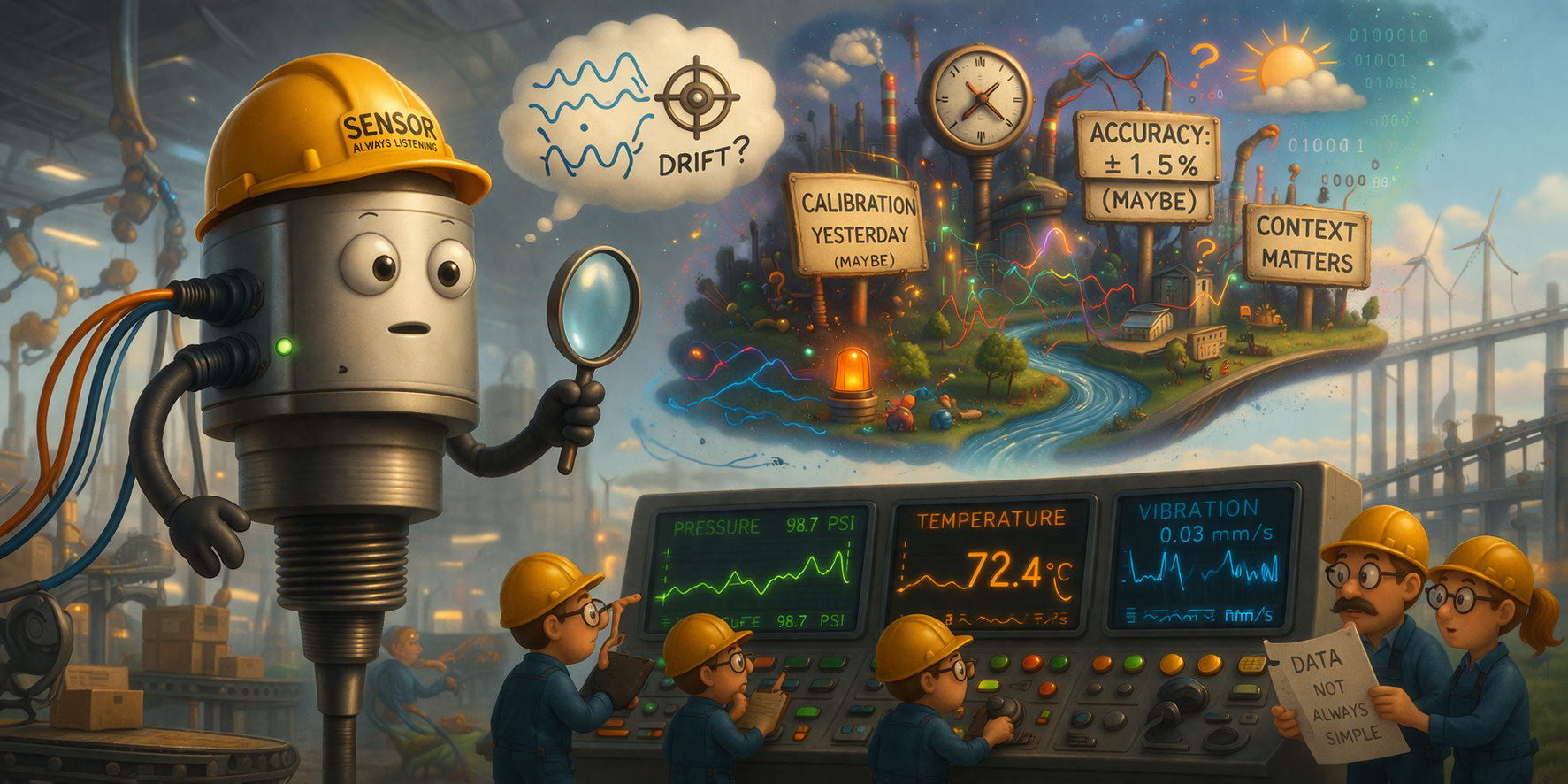
The signal a sensor produces is only as trustworthy as the environment it lives in. Industrial settings are not known for their hospitality. Heat fluctuates, machinery vibrates, and electrical noise sneaks into places it wasn't invited. A perfectly calibrated sensor on day one may begin to drift as these factors quietly nudge it off course.Drift is the slow, almost polite degradation of accuracy over time. It doesn't announce itself. It just gently shifts the truth. A pressure sensor that once read 100 psi might start reporting 102 psi under identical conditions. Nothing explodes. No alarms trigger. But decisions based on that data begin to lean in the wrong direction.
Sometimes the signal isn't wrong—it's just misunderstood. Sensors often respond faster or slower than expected. A sudden spike might be real, or it might be the sensor catching up after lagging behind. Interpreting these readings requires context, not just numbers. Without that context, a perfectly good sensor can look suspicious, like a witness who's technically correct but still raises eyebrows.
Calibration Is Not a One-Time Ritual
Calibration tends to be treated like a ceremonial event. Someone checks the sensor, adjusts it, signs a document, and everyone moves on. In reality, calibration is more like routine maintenance than a one-time fix. Sensors drift, environments change, and even the reference standards used for calibration can introduce subtle errors.A well-calibrated sensor aligns its output with known standards. But that alignment exists within a tolerance. No sensor is perfectly accurate; it's just accurate enough for the job. The difference matters. In a factory, a slight deviation might reduce efficiency. In infrastructure monitoring, it could mask early signs of failure.
Even the act of calibration can introduce quirks. Adjusting a sensor may improve accuracy at one range while slightly compromising another. It's a balancing act, not a reset button. And occasionally, the sensor behaves like it resents being corrected, drifting right back to its old habits as soon as no one is looking.
Accuracy Has Fine Print
A sensor's specification sheet often lists accuracy in neat percentages. It looks reassuring, almost comforting, until the details emerge. Accuracy might be defined under controlled conditions—stable temperature, clean power supply, and zero interference. Real-world environments rarely offer such courtesy.Accuracy also varies across the measurement range. A sensor that performs beautifully in the middle of its range may struggle near the extremes. That's not a flaw; it's a limitation. Still, systems sometimes treat all readings equally, as if a number near the edge carries the same certainty as one comfortably in the center.
Resolution adds another layer of confusion. A sensor might display very precise increments—say, to two decimal places—while its actual accuracy is far less impressive. The extra digits create a sense of confidence that isn't entirely earned. It's like someone speaking very clearly about something they only half understand.
Noise complicates everything further. Electrical interference, environmental fluctuations, and internal electronics all contribute to small variations in the signal. Filtering can smooth out these fluctuations, but excessive filtering risks hiding real changes. Too little filtering, and the data looks erratic. Too much, and it looks suspiciously calm.
Context Turns Data Into Meaning
A sensor reading is not a fact in isolation. It becomes meaningful only when paired with context—time, location, system behavior, and expectations. A temperature spike might signal a genuine problem, or it might reflect a temporary process change. Without context, the number sits there, technically correct and practically unhelpful.Operators and engineers often develop an intuition for this. They learn which sensors tend to drift, which ones react slowly, and which occasionally produce readings that seem to come from an alternate reality. That intuition isn't guesswork; it's experience layered on top of imperfect data.
Systems that rely purely on automated thresholds can struggle here. A sensor might cross a limit due to noise or drift, triggering alarms that lead nowhere. Over time, people begin to distrust the alerts. When a real issue arises, it risks being ignored because the system has cried wolf one too many times.
- Understand the environment your sensors live in
- Account for drift and schedule recalibration
- Interpret readings within operational context
- Balance filtering with responsiveness
Sense and Sensibility
Sensors don't lie, but they don't tell the whole story either. They translate a messy physical world into tidy signals, and something always gets lost in translation. Treating their output as absolute truth invites subtle errors that accumulate over time.A more grounded approach recognizes that every reading carries uncertainty. That uncertainty isn't a failure; it's part of the system. When acknowledged and managed, it leads to better decisions and more reliable operations. When ignored, it quietly reshapes outcomes in ways that are difficult to trace back.
Understanding sensors means listening carefully, questioning gently, and occasionally admitting that a perfectly reasonable number might still be slightly off.
 Our Blog